AI Codebases
02/12/2025
AI in Modern Development
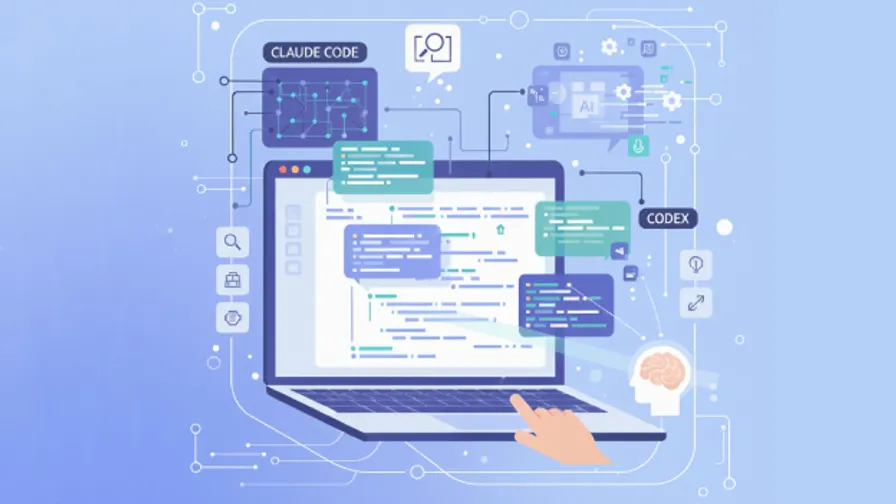
The use of AI tools inside code editors is becoming a standard part of the modern development workflow. These systems help produce cleaner, more understandable code, speed up development, and reduce the amount of routine work developers deal with every day. Among the most notable tools right now are Claude Code and Codex — each offering its own approach to analyzing codebases and interacting with the developer.
Context Awareness
The main advantage of these systems is their ability to understand project context. They go far beyond simple autocomplete: they analyze files, structures, relationships, and overall architecture. This makes the interaction with code more meaningful — you can quickly get an explanation for a fragment, request an improvement, or ask for a function that follows established patterns. The tool acts as an extension of the developer’s capabilities rather than a basic editor feature.
Claude Code focuses on deep analysis. It handles large files well, offers careful optimizations, and provides clear explanations of its reasoning. Its strength lies in understanding complex contexts where it’s important not just to complete a line but to grasp the logic of an entire module. This makes it suitable for large projects where structure and predictability matter.
Codex prioritizes interactivity and speed. It excels at generating templates, proposing quick solutions, and handling tasks that require fast responses: style conversions, data transformations, creation of helper functions. Its flexibility is especially useful in interface development or prototyping, where rapid iteration is crucial.
Reduced Cognitive Load
Despite their differences, both tools solve the same core problem — they reduce cognitive load. A developer no longer has to keep every project detail in mind: it’s enough to describe the intent, and the system will propose options that can be adapted to the task. This improves code reviews, increases code quality, and saves time typically spent searching for mistakes or optimal implementations.
Another advantage is the ability to work within a single environment. Integration with editors allows analysis, generation, and refactoring without switching tabs. This makes the workflow smoother, with fewer distractions and less need to consult documentation or external resources.
Conclusion
Overall, AI tools in code editors are becoming more than just assistants — they are turning into an integral part of the development process. They allow developers to focus on logic, architecture, and actual problem-solving instead of routine tasks. The result is faster, cleaner, and more comfortable development, which becomes especially evident in long-term projects where code structure and quality play a critical role.